Photosynthesis Light Reactions 3-D Model Making Kit


A hands-on way to teach the light reactions of photosynthesis!
Models are powerful tools for teaching science because they provide useful simplifications of structures and processes, helping to make the unseen seen and the complex simple.
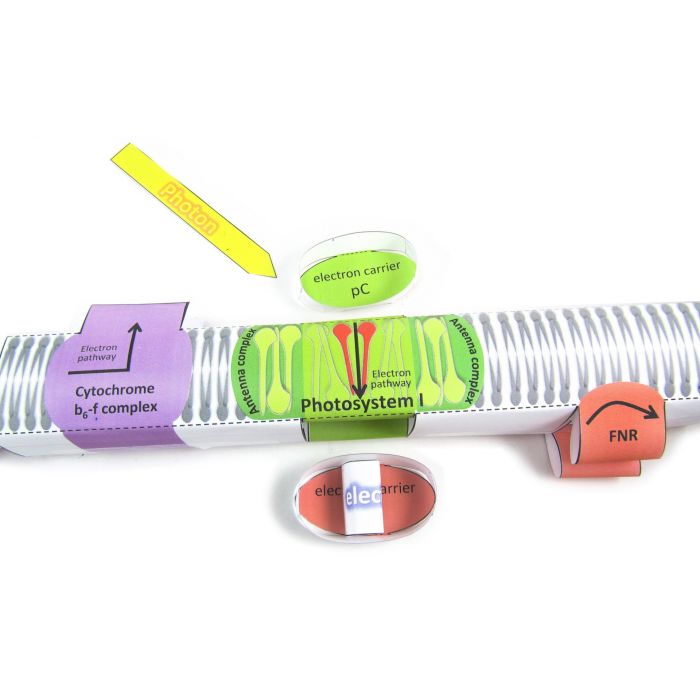
With this innovative model your students can follow how chloroplasts capture light energy and use it to synthesize sugars and other biomolecules. They will see how water is split when photons strike photosystem II and follow the electron carriers to photosystem I as ATP and NADPH are produced.
The set covers non-cyclic photophosphorylation, the Z scheme, NADPH synthesis, how the proton gradient for ATP synthesis is made, looks at the structures of the photosystems and cyclic photophosphorylation.
The Model Making Kit includes enough materials for students to assemble a paper model working cooperatively. The comprehensive Teacher Resource Guide included provides illustrated readings, activities, key vocabulary and an assessment, along with teaching opportunities for students to Engage, Explore, Explain, Extend and Evaluate their understanding of the concepts presented.