NewPath Learning ↗  ·  Teacher's Resource Guides

Science of Reading
Curriculum Collections

Five evidence-based curriculum collections aligned to the National Reading Panel's five pillars of literacy instruction. Each collection includes a comprehensive Teacher's Resource Guide with scope and sequence, format guidance, and differentiation strategies.
Shop Science of Reading Store ↗
Science of Reading Curriculum Collection
Grounded in the Simple View of Reading: RC = D × LC Reading Comprehension = Decoding × Language Comprehension
Collection 1 · Science of Reading
Phonological & Phonemic Awareness
Target: Early Childhood, Kindergarten, Grade 1 Focus: Rhyming, initial/ending sounds, sound blending, and word matching
National Reading Panel Finding
The NRP found that explicit PA instruction is most effective when it focuses on 1–2 phoneme manipulation skills at a time, is taught in small groups, and actively connects sounds to letters — bridging spoken language to print.
Concept Overview

Phonological awareness is the foundational ability to recognize and manipulate the spoken parts of sentences and words. This ranges from broad skills, like identifying syllables and rhyming words, to the most advanced level: phonemic awareness — the specific ability to hear, identify, and manipulate individual sounds (phonemes) in spoken words. This collection is designed to serve as a supplemental curriculum to your core literacy instruction, providing hands-on, engaging, and targeted practice for Early Childhood, Kindergarten, and 1st-grade students.

Format Types: When & How to Use Them

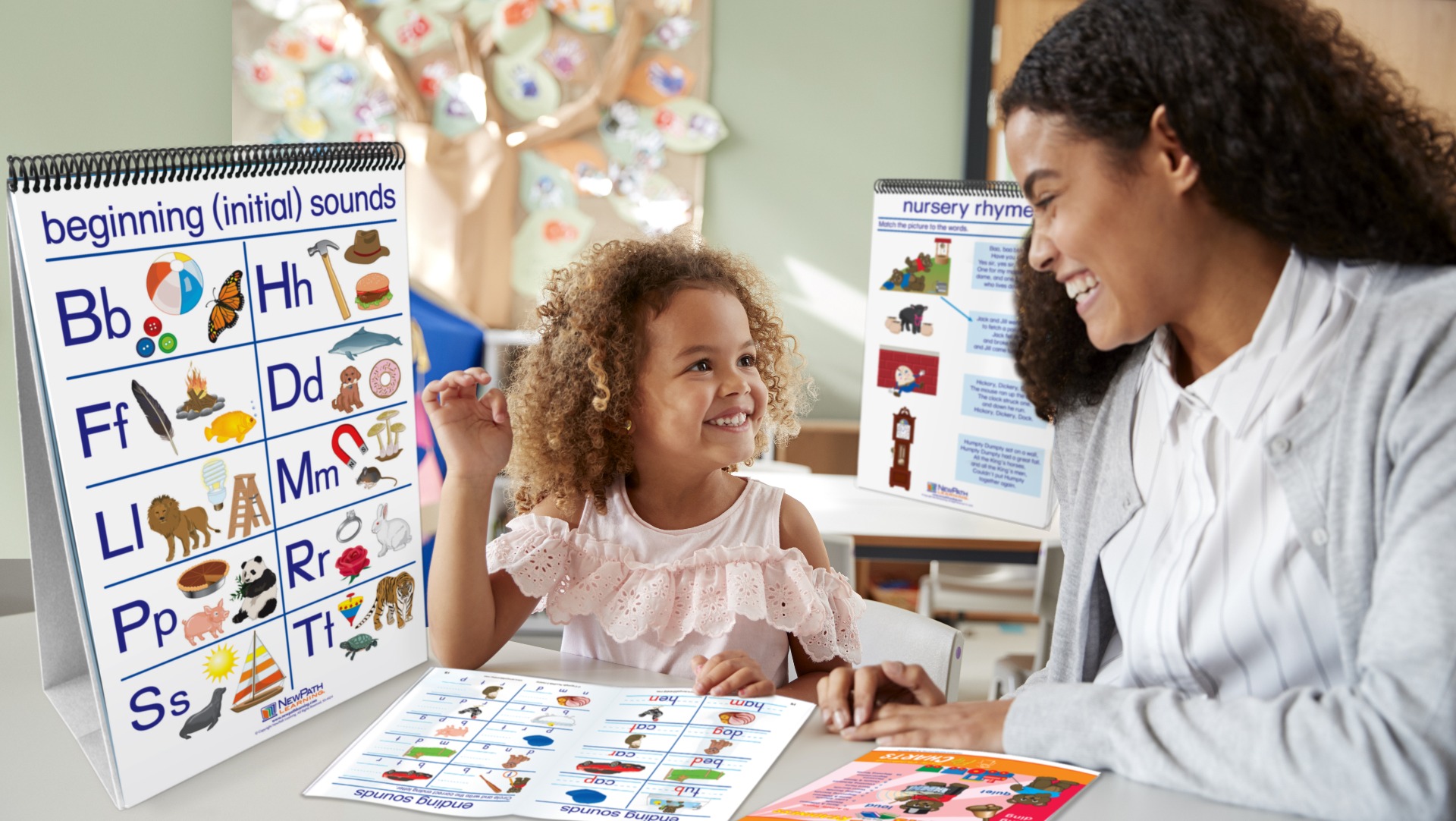
Large, easel-backed, spiral-bound charts featuring visually engaging, interactive lessons on one side and write-on/wipe-off dry-erase activities on the reverse.

Best For: Direct Instruction, Guided Practice, and Teacher-Led Small Groups
Whole-Class Introduction: Introduce a new phonemic awareness concept (e.g., rhyming) using the visual side of the chart. The large format ensures all students can see the visual cues.
Small Group 'I Do, We Do': Bring a small group to the teacher table. Model the skill on the visual side, then flip the chart and have students take turns using a dry-erase marker to complete the activities on the reverse side for immediate, corrective feedback.
Visual Anchor: Leave the chart open on a specific lesson during center time so students can reference the visual cues while working independently.

Ready-to-use, self-contained classroom centers that include a board game, illustrated game cards, and an instruction guide. Designed for 2 to 4 players.

Best For: Independent Practice, Collaborative Learning, and Repeated Exposure
Literacy Rotations: Set up the centers as permanent stations during your daily literacy block. The game-based format encourages high-repetition practice in a low-stakes, engaging environment.
Peer Tutoring: Pair a stronger reader with a struggling reader. The structured game rules allow the stronger student to model the skill while the struggling student practices.
Paraprofessional Intervention: Because the centers include clear instructions and self-checking mechanisms, they are ideal for paraprofessionals or parent volunteers to run with small pull-out groups.

Reproducible, structured activity pages that provide targeted practice on specific skills (like initial sounds or word matching).

Best For: Independent Seatwork, Formative Assessment, and School-to-Home Connection
Formative Assessment: After teaching a specific skill using the Flip Chart, assign the corresponding workbook page. Review completed pages to determine which students need further small-group intervention.
Morning Work/Bell Ringers: Use specific, targeted pages as morning work to activate prior knowledge and review previously taught skills.
Homework: Send pages home to provide parents with a structured way to reinforce foundational skills without requiring specialized training.
Suggested Scope & Sequence
1
Phase 1: Reading Readiness & Broad Phonological Awareness
Print awareness, letter recognition, and broad sound awareness.
Resources to Use
Begin the year by establishing foundational print concepts and letter recognition. Use the Flip Chart to introduce these concepts in whole-group settings, followed by targeted practice using the Activity Guide.
2
Phase 2: Rhyme Recognition and Production
Hearing and identifying rhyming words, then producing rhyming words.
Resources to Use
Teach rhyming explicitly using the Flip Chart. Once students can successfully identify rhymes with teacher guidance, transition them to the Learning Centers during literacy rotations for independent, repeated practice.
3
Phase 3: Phoneme Isolation (Initial and Ending Sounds)
Identifying the first and last sounds in spoken words and connecting them to letters.
Resources to Use
The NRP emphasizes that connecting sounds to letters is critical. Introduce initial sounds, using the workbook to assess mastery. Once initial sounds are secure, introduce ending sounds. Use the Learning Centers to provide ongoing, engaging practice for both skills simultaneously.
4
Phase 4: Phoneme Blending and Segmenting
Blending individual sounds to form words, and breaking words down into individual sounds.
Resources to Use
This is the most advanced and critical phase for reading development. Use the Flip Chart in small, targeted groups to model blending sounds. Follow up immediately with the Sound Jigsaws workbook to solidify the connection between the blended sounds and the printed word.
Differentiating Instruction
Students Needing Additional Support (Tier 2/3)
Best Format: Flip Charts (Teacher-Led)
Bring these students to the teacher table frequently. Use the dry-erase side of the Flip Charts to provide immediate, corrective feedback. Do not move them to independent Learning Centers until they demonstrate guided success. Focus heavily on Phase 3 (Initial/Ending Sounds) before attempting Phase 4 (Blending).
English Language Learners (ELLs)
Best Format: Learning Centers and Flip Charts
ELLs benefit from the rich visual supports provided by both the Flip Charts and the illustrated cards in the Learning Centers. The collaborative nature of the Learning Centers also provides essential oral language practice and peer modeling.
Advanced Students
Best Format: Workbooks and Advanced Learning Centers
Allow these students to move quickly through Phases 1 and 2. Challenge them with the Alphabet Activity Series - Sound Jigsaws and Word Matching workbook, and have them utilize the Ending Sounds Learning Center. You can also have them serve as peer models during Learning Center rotations.
Collection 2 · Science of Reading
Phonics & Word Recognition
Target: Grades K-5 Focus: Letter-sound correspondence, consonant blends, digraphs, vowels, word families, syllables, and spelling rules
National Reading Panel Finding
The NRP found that systematic, explicit phonics instruction significantly improves word recognition, spelling, and reading comprehension — especially in K-1. Instruction must include both decoding (reading) and encoding (spelling) practice, moving sequentially from simple CVC words to complex multisyllabic patterns.
Concept Overview

Phonics instruction systematically and explicitly teaches students the relationship between letters (graphemes) and sounds (phonemes). The goal is to help students learn the alphabetic principle so they can decode (read) and encode (spell) new words. This bundle provides the targeted, repetitive practice necessary to solidify phonics skills, covering everything from basic letter-sound correspondence and word families to advanced vowel teams, digraphs, and spelling patterns.

What's Included in This Collection
Product NameSKUFormatGrade
Decoding & Phonics Flip Chart Set, Grades 1-3 32-1002 Flip ChartGr. 1-3
Spelling Rules Flip Chart Set, Grades 3-6 32-3002 Flip ChartGr. 3-6
Word Families Curriculum Mastery Flip Chart Set - Early Childhood 32-0022 Flip ChartEarly Childhood
Word Families Student Activity Guide - Grades K-1 (Print) 12-0022 Teacher ResourceGr. K-1
Alphabet Flash Card Set of 27 42-3500 Game/Hands-onAny
Alphabet Lap Card Set of 27 42-3501 Game/Hands-onAny
Word Families Early Childhood Learning Center, Gr. K-1 22-0028 Learning CenterGr. K-1
Short Vowels Learning Center, Gr. 1-2 22-1914 Learning CenterGr. 1-2
Long Vowel - Silent "e" Learning Center, Gr. 1-2 22-1915 Learning CenterGr. 1-2
Consonant Blends & Digraphs Learning Center, Gr. 1-2 22-1912 Learning CenterGr. 1-2
Vowel Digraphs Learning Center, Gr. 1-2 22-1920 Learning CenterGr. 1-2
Syllables Learning Center, Gr. 1-2 22-1924 Learning CenterGr. 1-2
R-Controlled Vowels Learning Center, Gr. 3-5 22-3910 Learning CenterGr. 3-5
Vowel Diphthongs Learning Center, Gr. 3-5 22-3919 Learning CenterGr. 3-5
Spelling – Plurals and Possessives Learning Center, Gr. 3-5 22-3929 Learning CenterGr. 3-5
Spelling and Patterns Learning Center, Gr. 6-8 22-6912 Learning CenterGr. 6-8
Spelling Guidelines Learning Center, Gr. 6-8 22-6937 Learning CenterGr. 6-8
Phonics Board Games Workbook Gr. 1-2 W12-1005 WorkbookGr. 1-2
Essential Phonics Series - Vowels Workbook Gr. 2-3 W12-2001 WorkbookGr. 2-3
Essential Phonics Series - More Vowels Workbook Gr. 2-3 W12-2002 WorkbookGr. 2-3
Essential Phonics Series - Consonants Workbook Gr. 2-3 W12-2003 WorkbookGr. 2-3
Format Types: When & How to Use Them

Large, easel-backed charts featuring interactive visual lessons on one side and write-on/wipe-off dry-erase activities on the reverse.

Best For: Direct Instruction, Guided Practice, and Explicit Rule Teaching
Explicit Phonics Mini-Lessons: Use the visual side of the Decoding & Phonics or Spelling Rules charts to explicitly teach a new phonics pattern (e.g., the 'magic e' rule). The visual anchor helps students grasp abstract rules.
Guided Encoding (Spelling) Practice: Flip the chart to the dry-erase side. Call out a word that follows the rule just taught, and have students take turns writing the word on the chart, explaining the spelling pattern as they write.

Self-contained game centers (board games with cards) and tactile flash/lap cards designed for interactive play and rapid word recognition.

Best For: Independent Practice, Peer Collaboration, and Automaticity Building
Literacy Rotations: Because phonics requires massive repetition to achieve automaticity, set up the Learning Centers as permanent stations. Students can play the games repeatedly without losing engagement.
Warm-Up Drills: Use the Alphabet Flash/Lap Cards for rapid-fire 2-minute warm-up drills at the beginning of small group instruction to build automatic letter-sound recall.

Reproducible, structured activity pages providing targeted practice on specific spelling and phonics patterns.

Best For: Independent Seatwork, Formative Assessment, and Homework
Formative Assessment: After teaching a specific vowel team using a Flip Chart, assign the corresponding page from the Essential Phonics Series workbooks to provide concrete data on mastery.
Intervention Folders: Compile specific pages from the workbooks into personalized folders for Tier 2/3 students, allowing them to practice their specific deficit areas during independent work time.
Suggested Scope & Sequence
1
Phase 1: Letter-Sound Mastery & Word Families (Grades K-1)
Mastering all individual letter sounds and recognizing simple CVC word families.
Resources to Use
Ensure students have automatic recall of consonant and short vowel sounds. Teach word families (e.g., -at, -op) using the Flip Chart, then move students to the Learning Centers for repeated exposure to these foundational patterns.
2
Phase 2: Blends, Digraphs, and the 'Magic E' (Grades 1-2)
Decoding words with consonant blends (bl, str), consonant digraphs (sh, ch, th), and the CVCe (silent e) pattern.
Resources to Use
Use the Flip Chart to explicitly teach the difference between a blend (two sounds) and a digraph (one sound). Follow up with the Learning Centers. Teach the 'Magic E' rule explicitly, as this is often a major hurdle for early readers.
3
Phase 3: Advanced Vowel Teams and Syllabication (Grades 2-3)
Decoding complex vowel digraphs (ea, oa), diphthongs (oi, ou), r-controlled vowels (ar, er), and breaking words into syllables.
Resources to Use
As texts become more complex, students must recognize vowel teams as single units of sound. Introduce one vowel team at a time using the workbooks, then provide the corresponding Learning Center for practice. Simultaneously, use the Syllables Learning Center to teach students how to break longer words into manageable, decodable chunks.
4
Phase 4: Complex Spelling Rules and Morphology (Grades 3-6+)
Applying phonics knowledge to encoding (spelling), understanding plurals, possessives, and advanced spelling guidelines.
Resources to Use
By 3rd grade, the focus shifts heavily from decoding to encoding (spelling) and morphological awareness. Use the Flip Chart to teach explicit spelling rules (e.g., dropping the 'e' before adding '-ing'). Use the upper-grade Learning Centers to provide engaging practice for these often-dry spelling rules.
Differentiating Instruction
Students Needing Additional Support (Tier 2/3)
Best Format: Flash Cards and Flip Charts (Teacher-Led)
If a student is struggling in Phase 3 (Vowel Teams), they likely have a deficit in Phase 1 or 2. Do not push them forward. Bring them to the teacher table and use the Alphabet Flash Cards and Short Vowels Learning Center in a highly guided, 1-on-1 setting until automaticity is achieved.
English Language Learners (ELLs)
Best Format: Learning Centers and Workbooks
ELLs often struggle with English phonemes that do not exist in their native language (e.g., the /th/ digraph or short /i/ vs short /e/). Provide extensive auditory modeling using the Consonant Blends & Digraphs Learning Center. Pair the games with visual vocabulary support so they understand the meaning of the words they are decoding.
Advanced Students
Best Format: Advanced Spelling Learning Centers
If a 1st or 2nd grader has mastered Phase 3 decoding, move them immediately into Phase 4 encoding. Have them use the Spelling Rules Flip Chart independently or work through the Spelling and Patterns Learning Center to challenge their writing and spelling capabilities.
Collection 3 · Science of Reading
Fluency
Target: Grades 2-5 Focus: Automatic word recognition, sight words, repeated reading, and reading with expression (prosody)
National Reading Panel Finding
The NRP concluded that guided, repeated oral reading with feedback is the most effective way to improve reading fluency and overall comprehension. Fluency is not simply 'reading fast' — it involves accuracy, automaticity, and prosody (reading with expression that reflects meaning).
Concept Overview

Fluency is often described as the bridge between decoding words and comprehending text. It is the ability to read text accurately, quickly, and with proper expression (prosody). When students are fluent, they no longer have to expend all their cognitive energy on decoding individual words, freeing up their working memory to focus on what the text actually means. This bundle focuses on building the automaticity of high-frequency words and vocabulary through game-based repetition, and applying that automaticity to connected text.

Format Types: When & How to Use Them

Comprehensive game sets designed for up to 36 students simultaneously. They include multiple game boards, hundreds of question cards focusing on high-frequency words and vocabulary, and teacher management materials.

Best For: Whole-Class Engagement, Literacy Rotations, and Building Automaticity
Friday Fluency Tournaments: Use the Class-Packs to run a whole-class review session. The game mechanics incentivize rapid, accurate recall of high-frequency words and spelling patterns, which builds the automaticity required for fluent reading.
Small Group 'Speed Rounds': During small group instruction, use just the question cards as flashcards. Have students read the words as quickly and accurately as possible, graphing their speed to track progress over time.
Peer-to-Peer Feedback: The NRP stresses that fluency improves with feedback. Have students play the games in pairs, instructing them to gently correct their partner if a word is misread.

Reproducible activity pages that focus on applying reading skills to practical, real-world texts (e.g., menus, schedules, signs).

Best For: Connected Text Practice, Independent Seatwork, and Prosody Practice
Repeated Oral Reading: Do not just use the Real Life Reading Workbook for silent seatwork. Have students read the short, practical texts aloud to you or a partner. Have them read the same text three times in a row, focusing on improving their expression and pacing with each read.
'Real World' Prosody: Use the workbook to teach prosody (expression). Ask students, 'How would a train conductor announce this schedule?' or 'How would a waiter read this menu?' This forces them to think about intonation and phrasing rather than just word-calling.
Suggested Scope & Sequence
1
Phase 1: High-Frequency Word Automaticity
Rapid, accurate recognition of sight words, common vocabulary, and spelling patterns without the need to decode.
Resources to Use
Before students can read sentences fluently, they must read individual words automatically. Introduce the Class-Pack games during your literacy block. Ensure students are reading the words on the cards aloud during gameplay, not just silently choosing answers. This oral component is critical for building the neurological pathways for automaticity.
2
Phase 2: Applying Automaticity to Connected Text
Reading sentences and short passages with accuracy, appropriate speed, and expression (prosody).
Resources to Use
Once students demonstrate automaticity with isolated words during gameplay, transition them to reading connected text. Use the short passages in the workbook for guided oral reading. Listen to the student read, provide immediate feedback on their pacing and expression, and have them re-read the passage applying your feedback.
Differentiating Instruction
Students Needing Additional Support (Tier 2/3)
Best Format: Game Cards (Used as Flashcards) and Teacher-Led Workbook Reading
Struggling readers often suffer from a lack of automaticity. Pull these students into a small group and use the game cards for rapid-fire practice. When using the Real Life Reading Workbook, utilize Choral Reading (reading aloud together with the student) or Echo Reading (you read a sentence with expression, and the student echoes it back exactly).
English Language Learners (ELLs)
Best Format: Real Life Reading Workbook
ELLs may be able to decode fluently but lack the prosody (expression) because they do not fully understand the syntax or vocabulary. The Real Life Reading Workbook is excellent for ELLs because it uses highly contextualized, practical texts (menus, signs). Pre-teach the vocabulary, then focus heavily on modeling the correct intonation of the sentences.
Advanced Students
Best Format: Class-Pack Games (Student-Led) and Independent Workbook Application
Advanced students who are already fluent readers can use the Class-Pack games independently to build advanced vocabulary. You can also challenge them to read the Real Life Reading texts aloud with exaggerated expression, or have them write their own 'real-life' texts (like a mock restaurant menu) and read them fluently to the class.
Collection 4 · Science of Reading
Vocabulary & Oral Language
Target: Grades 3-8 Focus: Synonyms, antonyms, homophones, root words, prefixes, suffixes, analogies, and context clues
National Reading Panel Finding
The NRP established that vocabulary instruction must be multi-faceted: relying solely on dictionary definitions is ineffective; words must be learned in rich contexts. Explicit instruction in morphology (roots, prefixes, suffixes) is highly effective, and multiple exposures to a word across different contexts are required for true mastery.
Concept Overview

Vocabulary is a critical component of language comprehension, which, according to the Simple View of Reading, is half of the reading comprehension equation (Decoding × Language Comprehension = Reading Comprehension). A student cannot understand a text if they do not know the meaning of the words they are decoding. This bundle moves students beyond rote memorization, teaching them how to analyze word structures (structural analysis), understand word relationships (synonyms, antonyms, analogies), and use context clues to derive meaning.

What's Included in This Collection
Format Types: When & How to Use Them

Visual instruction tools. The Flip Chart provides explicit visual lessons on vocabulary strategies, while the laminated Graphic Organizers provide reusable templates (like the Frayer Model) for deep word study.

Best For: Direct Instruction, Deep Word Study, and Semantic Mapping
Explicit Strategy Instruction: Use the Flip Chart to explicitly teach how to use context clues or how to break apart a word using its morphological components.
Deep Word Study (The Frayer Model): Use the Word Mapping Graphic Organizers when introducing Tier 2 (high-utility academic) vocabulary. Have students map the word by providing the definition, an illustration, examples, and non-examples. The dry-erase surface allows for continuous reuse.

Ready-to-use, self-contained classroom centers that include a board game and illustrated game cards focusing on specific vocabulary skills.

Best For: Independent Practice, Repeated Exposure, and Collaborative Learning
Vocabulary Rotations: Because the NRP states that multiple exposures are necessary for vocabulary acquisition, set up the Learning Centers as permanent stations. The game format encourages students to encounter the same words repeatedly in a fun, engaging way.
'Just the Cards' Sorting: For a quick activity, remove the board game and have students sort the cards (e.g., sorting the prefix cards into piles based on meaning: 'not,' 'again,' 'before').
Suggested Scope & Sequence
1
Phase 1: Word Relationships (Synonyms, Antonyms, Homophones)
Understanding how words relate to one another to build a richer semantic network.
Resources to Use
Begin by expanding the vocabulary students already have. Teach them that instead of saying 'good,' they can use synonyms like 'excellent' or 'superb.' Use the Learning Centers to practice identifying these relationships rapidly.
2
Phase 2: Introduction to Morphology (Prefixes and Suffixes)
Understanding that words are built from smaller, meaningful parts (morphemes), and that adding a prefix or suffix changes the word's meaning or part of speech.
Resources to Use
Explicitly teach the most common prefixes (un-, re-, in-, dis-) and suffixes (-s, -ed, -ing, -ly). Explain that if they know what 're-' means (again), they can figure out what 'rebuild' means. Use the Learning Centers for repeated practice identifying and defining these affixes.
3
Phase 3: Advanced Morphology and Structural Analysis
Breaking down complex, multisyllabic academic words into their Greek and Latin roots and affixes.
Resources to Use
This is critical for middle school success. Teach students to be 'word detectives.' When they encounter a long word, use the Graphic Organizers to break it down: Prefix + Root + Suffix. The Gr. 6-8 Learning Centers provide rigorous practice in identifying Greek and Latin roots.
4
Phase 4: Context Clues, Analogies, and Figurative Language
Deriving the meaning of unknown words from the surrounding text, understanding complex logical relationships, and interpreting non-literal language.
Resources to Use
Teach the specific types of context clues (definition, synonym, antonym, inference) using the Flip Chart. Use the Analogies centers to build critical thinking and logical reasoning skills (e.g., Part to Whole, Cause to Effect). Finally, introduce figurative language (idioms, metaphors) as this often trips up literal readers.
Differentiating Instruction
Students Needing Additional Support (Tier 2/3)
Best Format: Word Mapping Graphic Organizers (Teacher-Led)
Struggling readers often lack the vocabulary to understand grade-level text. Do not overwhelm them with long lists of words. Select 3-5 high-utility Tier 2 words per week. Use the Word Mapping Graphic Organizers in a small group to deeply explore these words. Drop down to the Gr. 1-2 Prefix/Suffix Learning Centers to build foundational morphological awareness before attempting structural analysis.
English Language Learners (ELLs)
Best Format: Graphic Organizers and Morphology Centers
ELLs benefit immensely from morphological instruction, especially if their native language shares Latin or Greek roots (like Spanish). Explicitly teach cognates (words that look/sound similar and mean the same thing across languages). The Word Mapping Organizers are essential for ELLs, as the 'Illustration' quadrant allows them to connect the English word to a visual concept.
Advanced Students
Best Format: Analogies and Structural Analysis Learning Centers
Push advanced students to use the Analogies and Structural Analysis centers. Challenge them to find 5 words in their independent reading book that share a specific Greek or Latin root, and have them present their findings to the class.
Collection 5 · Science of Reading
Text Comprehension
Target: Grades 3-8 Focus: Main idea, sequencing, text structure, cause and effect, drawing conclusions, inferences, graphic organizers, and literary elements
National Reading Panel Finding
The NRP found that comprehension is not automatic and must be explicitly taught using multiple strategies simultaneously. The most effective approaches include: using graphic organizers to map text structure, teaching students to monitor their own understanding (metacognition), and using cooperative learning to discuss texts.
Concept Overview

Comprehension is the ultimate goal of reading. According to the Simple View of Reading, once a student can fluently decode text and has the vocabulary to understand the language, they must apply cognitive strategies to extract meaning from the text. The NRP identified several highly effective strategies: graphic organizers, text structure awareness, summarization, and question answering. This bundle provides a comprehensive array of resources to explicitly teach, practice, and map out these cognitive comprehension strategies for Grades 3-8.

What's Included in This Collection
Product NameSKUFormatGrade
Reading Comprehension Flip Chart Set, Grades 4-8 32-4004 Flip ChartGr. 4-8
Thinking Graphically About Reading - Strategies Flip Chart Set 32-1010 Flip ChartAny
ELA / Reading Graphic Organizers Laminated Set of 6 67-8500 Graphic OrganizerAny
Flow Chart and Mountain Thinking Graphic Organizers Laminated Set of 10 67-8503 Graphic OrganizerAny
Venn Diagram and T-Chart Graphic Organizers Laminated Set of 10 67-8501 Graphic OrganizerAny
Bracketed Boxes and Cause & Effect Graphic Organizers Laminated Set of 10 67-8502 Graphic OrganizerAny
Main Idea and Supporting Details Learning Center, Gr. 3-5 22-3924 Learning CenterGr. 3-5
Cause and Effect Learning Center, Gr. 3-5 22-3934 Learning CenterGr. 3-5
Drawing Conclusions Learning Center, Gr. 3-5 22-3932 Learning CenterGr. 3-5
Inferences Learning Center, Gr. 3-5 22-3925 Learning CenterGr. 3-5
Summarize Learning Center, Gr. 3-5 22-3933 Learning CenterGr. 3-5
Nonfiction Text Features Learning Center, Gr. 3-5 22-3921 Learning CenterGr. 3-5
Expository Text Features Learning Center, Gr. 6-8 22-6938 Learning CenterGr. 6-8
Author's Purpose Learning Center, Gr. 3-5 22-3915 Learning CenterGr. 3-5
Author's Craft: Purpose & Point of View Learning Center, Gr. 3-5 22-3937 Learning CenterGr. 3-5
Author's Purpose & Point of View Learning Center, Gr. 6-8 22-6920 Learning CenterGr. 6-8
Sequential Order Learning Center, Gr. 3-5 22-3916 Learning CenterGr. 3-5
Sequencing Learning Center, Gr. 6-8 22-6917 Learning CenterGr. 6-8
Making Predictions Learning Center, Gr. 6-8 22-6915 Learning CenterGr. 6-8
Fact and Opinion Learning Center, Gr. 3-5 22-3914 Learning CenterGr. 3-5
Reading: Fact and Opinion Learning Center, Gr. 3-5 22-3935 Learning CenterGr. 3-5
Literary Elements Learning Center, Gr. 3-5 22-3923 Learning CenterGr. 3-5
Literary Genres Learning Center, Gr. 3-5 22-3936 Learning CenterGr. 3-5
Format Types: When & How to Use Them

Large, visual instruction tools featuring lessons on one side and dry-erase activities on the other.

Best For: Direct Instruction and Strategy Modeling
Think-Aloud Modeling: Comprehension happens invisibly in the brain. Use the Flip Charts to make it visible. While displaying a strategy (e.g., Making Inferences) on the chart, 'think aloud' for your students, explaining exactly how you are combining text evidence with your background knowledge.

Reusable, dry-erase templates (Venn Diagrams, Flow Charts, Story Mountains) that visually map out text structures.

Best For: Guided Practice, During-Reading Activities, and Text Structure Analysis
During-Reading Mapping: Do not wait until a text is finished to check comprehension. Have students keep a laminated Graphic Organizer (like the Cause & Effect map) on their desk while they read, filling it out with a dry-erase marker as they encounter new information.

Game-based centers focusing on specific, isolated comprehension skills (e.g., Main Idea, Sequencing).

Best For: Independent Practice, Skill Isolation, and Collaborative Discussion
Debate and Justify: The NRP found that collaborative discussion improves comprehension. When students play the Learning Center games, institute a 'Justify It' rule. A student cannot simply give an answer; they must explain why it is the main idea or what text evidence led them to that inference.
Suggested Scope & Sequence
1
Phase 1: Literal Comprehension and Text Structure
Identifying the basic facts, sequencing events, and understanding how a text is organized.
Resources to Use
Begin by ensuring students can track what is happening in a text. Teach them to use headings, captions, and glossaries (Text Features) to navigate nonfiction. Use the Flow Chart organizers to help them map the sequence of events in a narrative.
2
Phase 2: Core Analytical Strategies
Identifying the main idea, summarizing, and distinguishing fact from opinion.
Resources to Use
Once students can track the literal events, teach them to synthesize that information. Use the Flip Chart to teach the difference between a main idea (the big picture) and a supporting detail (the evidence). Use the Learning Centers to practice summarizing short passages accurately.
3
Phase 3: Inferential Comprehension
'Reading between the lines' to draw conclusions, make predictions, and identify cause and effect.
Resources to Use
This is often the hardest phase for students. Explicitly teach the formula for an inference: Text Evidence + Background Knowledge = Inference. Have students use the Cause & Effect graphic organizers to visually map out why things are happening in the text before moving them to the independent Learning Centers.
4
Phase 4: Literary Analysis and Author's Craft
Understanding why the author wrote the text, analyzing literary elements, and comparing texts.
Resources to Use
In this final phase, students analyze the text as a constructed piece of art. Use the Learning Centers to practice identifying the author's purpose (Persuade, Inform, Entertain). Use the Venn Diagrams to have students compare how two different authors approach the same topic or genre.
Differentiating Instruction
Students Needing Additional Support (Tier 2/3)
Best Format: Graphic Organizers (Heavily Scaffolded)
Struggling comprehenders easily lose track of information in long texts. Chunk the text into smaller paragraphs. After every paragraph, stop and have the student fill out one box on a Graphic Organizer (like a Story Mountain or Flow Chart). Do not move them to abstract inferencing (Phase 3) until they can accurately sequence and summarize (Phases 1 & 2).
English Language Learners (ELLs)
Best Format: Graphic Organizers and Text Features Centers
ELLs rely heavily on visual cues to aid comprehension. Spend extra time in Phase 1 using the Nonfiction Text Features Learning Center, teaching them how to use pictures, graphs, and bold words to understand the text before they even read the paragraphs. The Graphic Organizers are also essential for helping them visually map relationships (like Cause/Effect) without relying solely on complex English syntax.
Advanced Students
Best Format: Author's Craft and Inferencing Learning Centers
Push advanced students past literal recall immediately. Have them focus heavily on Phase 4 (Author's Craft). Challenge them to use the Venn Diagram to compare the theme of a fictional story with the main idea of an informational text on the same topic.
© 2007-2026 NewPath Learning. All Rights Reserved.